09 Sep 2026

Beyond Rugby: Andy Nicol on Building a Second Career

For most people, changing career is a significant moment. When the career you are leaving behind has involved captaining your country, playing international rugby in front of 67,000 people and spending much of your adult life in professional sport, that transition becomes something altogether different.

Market Report Images


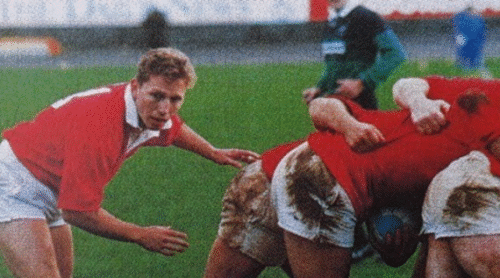
Andy Nicol retired from professional rugby in 2003, bringing to an end a career that had seen him captain Scotland, Glasgow and Bath. What followed was not retirement in the traditional sense, but the beginning of an entirely new chapter spanning broadcasting, public speaking and business. Today, alongside his long-standing role as a P+B Ambassador, Andy is CEO of Abstract, an award-winning Training and Development company drawing on many of the skills and experiences built across both his sporting and professional careers.

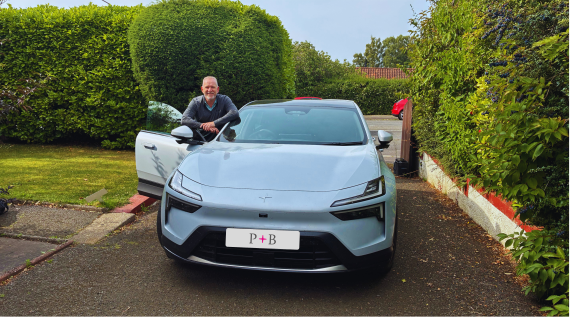
We previously sat down with Andy to talk about his journey with electric vehicles. This time, with Andy recently taking delivery of his new Polestar 4 through P+B, we wanted to talk about something completely different: how he made the transition from professional sport into the professional world, what rugby taught him about business, and the lessons he has picked up along the way.

When you retired from professional rugby in 2003, did you know what came next?

I did. I was lucky, I guess, but there was also an element of designing that. I prepared for that moment. It wasn’t the doctor telling me that I couldn’t play anymore, or the coach telling me I couldn’t play anymore. It was my choice, which I’d probably made six months before I eventually stopped in May 2003.

That meant I could prepare for it. It wasn’t one career ending and then starting on day one looking for the next one. I’d already started doing quite a lot of things, and media was one of them.

Towards the end of my career, I was injured quite a bit, so I was doing commentary with the BBC at the side of the pitch and sometimes full commentary. I’d also done some work around the 1995 Rugby World Cup when I missed it through a serious knee injury, so I’d always been interested in media.

One of the big drivers for retiring when I did was actually the 2003 World Cup in Australia. I had an opportunity to go with the BBC and work on the radio coverage. They weren’t flying me out there and putting me up for five weeks; they were essentially booking me for Scotland’s four games and one other. But I thought it was a great opportunity.

If I’d kept playing, I wouldn’t have been able to do it.

I went out to Australia in October and November and did the games as planned. In the final week, when Scotland were playing Australia in the quarter-final, I met the head of BBC TV Rugby, who booked me for the following Six Nations in 2004.

I then did every Six Nations through to 2023. It was a great investment and a great decision. One of the things the BBC later told me they admired was that I’d shown a willingness to go out and make it happen rather than waiting for the tap on the shoulder.

That’s probably one of the biggest pieces of advice I’d give anyone moving from one career to another, or even progressing within one career: never wait for the tap on the shoulder.

You never know when it’ll come. I was a former captain of Scotland and had experience with the BBC, so perhaps the tap would have come eventually. I made sure it came by going to Australia.

Was broadcasting always going to be the next career?

It was only one part of it.

When I decided I was retiring, I obviously did that in conjunction with my wife. Our eldest daughter was three and we were about to have our second daughter, so any decision I made was a family decision.

I didn’t want to move from rugby straight into one other form of work and depend entirely on that. Instead of trying to get that from one job, I opened up maybe six different bits of work and treated them as separate income streams.

I coached Currie Rugby Club for a season, which I thought I was going to enjoy, and I didn’t. That’s no reflection on Currie whatsoever. They gave me a fantastic opportunity and we had a brilliant set-up, but I realised quite quickly that I was just bored of rugby. After all those years playing it, I’d lost that spark.

I also did journalism, columns for newspapers, radio, television and some business work. The business side was really about using the network I’d built during rugby and working out what I actually wanted to do.

I’d studied Business Studies at university and graduated before rugby became professional. I straddled the amateur and professional eras and ended up spending seven years as a professional player, but I still wanted to use that business degree.

Business is obviously hugely diverse. Was I interested in sales? Marketing? Front office? Back office? I tried a number of things and used my network to understand where I fitted.

Rather than having one source of income and putting all my eggs in one basket, I diversified. I suppose I diversified the risk of trying to build a successful life after rugby.

And generally, it worked.

Did you ever struggle with losing the identity of being a professional rugby player?

Not really.

For some professional sportspeople, when you retire, that identity disappears. Playing at Murrayfield in front of 67,000 people, Twickenham in front of 80,000 or Stade de France in front of more than 80,000 is a huge thrill, and that can leave a big hole to fill.

Because I went almost immediately into television, that filled the void for me. I didn’t crave rugby anymore.

About six weeks after retiring, I was working on a warm-up game at Murrayfield for the BBC. We were standing at the side of the pitch doing the pre-match coverage when the game kicked off and there was a huge tackle right in front of us. I instinctively winced and moved away.

John Inverdale looked at me and said, “What’s wrong with you?”

I said, “Look how physical that is.”

He said, “Andy, that was you six weeks ago.”

I’d completely switched off from it. My mind had moved on to the next job and the next part of my life.

Going back to Murrayfield or watching Scotland was easy because I was there working. There was still an element of nerves, but they were different nerves. You’re performing live on television in front of eight or nine million people. You still get the adrenaline and there’s still that recognition.

A lot of people who struggle after a sporting career talk about that loss of identity and recognition. Television allowed me to retain some of that while creating a completely different identity for myself.

I’m not saying the transition was without problems or moments of stress, but I found retirement from rugby relatively easy because I’d planned it, thought it through and immediately had something else to move into.

And television did me for another 20 years.

How important was it to find something you genuinely enjoyed?

You’ve got to follow your passion.

I really enjoyed television. I got a buzz standing at the side of the pitch being asked questions. I’d enjoyed press conferences when I was captain of Scotland, Glasgow and Bath. I enjoyed being asked questions, responding and being live.

Over the years I’ve realised that sometimes the minutiae and the detail aren’t necessarily my greatest strengths. But when it’s live, I excel.

Television then led into public speaking. I started speaking at events and dinners and saw that as another development. Yes, it was another income stream, but I also discovered that I genuinely loved it.

I’ve always enjoyed public speaking. When you’re captaining rugby teams from the age of 12, 13 or 14, you’re the one who has to stand up and thank the opposition, the referee and the people who’ve made the tea, and if you make the slightest mistake, your mates are straight onto you.

Today I host some very large events, sometimes in front of around 1,500 people. Standing up there, linking the event together, interviewing people, doing Q&As and running an auction, I love it. I get a real buzz and a real sense of satisfaction from it.

A lot of the things I’ve done professionally since rugby have recreated elements of what I loved about sport: achievement, challenge, winning together, losing together, being part of a team and performing under pressure.

I’ve realised I’m at my best when I’m under pressure. I get confidence from knowing I can cope in that environment, whether that’s saying the right thing at the right moment in a meeting, pitching for a new client, speaking in front of 1,500 people or trying to squeeze as much money as possible out of a room during a charity auction.

In that moment, when you’re performing under pressure, I love it.

What skills from rugby and broadcasting have transferred into business?

Television taught me an enormous amount.

When you’ve only got 20 seconds to make a point, you’ve only got 20 seconds. It teaches you very quickly to construct good sentences, be concise, be coherent, get your point across and not fluff your way into or out of it.

When you’re live, there’s no safety net. You can’t get 20 seconds into an answer with Gabby Logan or John Inverdale and say, “Sorry, that’s a terrible answer. Ask me again and I’ll do it better.”
You have to get it right first time.

I’ve been able to use that skill in business to great effect. You can use exactly the same skill set to deliver a pitch, open a conference or communicate something clearly in a meeting.

Transferable skills are hugely important. Clearly there are plenty of rugby skills you can’t transfer into media or business, but a lot of the discipline can be transferred, as can that ability to communicate and perform under pressure.

Interestingly, having now spent more than 20 years in business, if I went back into rugby I would take an awful lot of what I’ve learned in business and apply it to sport.

Business is very quick and very willing to learn from sport. I’m not always sure sport is as willing to learn from business.

I think it should be a two-way street.

Market Report Images 24

You talk a lot about the importance of ‘soft skills’. Where did those come from for you?

I was very lucky because I straddled the amateur and professional eras.

When I first got into the Scotland squad, the changing room contained people from a complete mix of professions. There were doctors, lawyers, tradespeople, people working in insurance, people working on farms, students and everything in between.

All of those people brought different life skills into that changing room. You learned different leadership techniques from different people because their leadership hadn’t only been developed in rugby. It had been developed in legal environments, medical environments, businesses and workplaces.

By the end of my career, rugby was fully professional. Today, virtually everyone in an international changing room may have gone straight from school into professional rugby. Their leadership experience can still be excellent, but it’s inevitably more linear because much of it has been learned within one environment.

The richness of experience I had as a young player was incredible. I got my first cap when I was 20. I didn’t know anything. I was just a sponge.

I was sharing a changing room with people like Finlay Calder, David Sole, Derek White and John Jeffrey, iconic names in Scottish rugby, when I was 19 or 20 years old. I was learning all the time. I didn’t necessarily know what I was learning, but I knew I was learning.

One example is emotional intelligence. It’s a phrase that has become much more widely used over the last 15 or 20 years, but nobody called it emotional intelligence when I was coming through rugby.
When you understand it as recognising your own feelings, behaviours and emotions as well as those of other people, I realised I’d actually become very good at it without knowing what it was.

That came from captaining teams from a young age. I learned quite early that you couldn’t use the same leadership or management style with 20 different people and expect exactly the same response.
If you’re trying to motivate a team, some people need the carrot and some need the stick. Using one communication style isn’t going to get the same response from everyone.

Fundamentally, that’s emotional intelligence: understanding how you come across, understanding other people and changing your approach accordingly.

Are those human skills becoming even more important as technology develops?

Absolutely.

As we become more digitised and AI-enabled in how we operate, I think those skills become even more valuable.

Covid accelerated that. There was a whole period where a lot of younger people entering businesses simply didn’t get to see how experienced people operated in person. You learn from role models. You see how someone senior handles a difficult client conversation or deals with a difficult situation, and you absorb it.

You can’t replicate all of that through Zoom or virtually.

Technology is great. We can do so much more and connect globally in a way we simply couldn’t before. We run global programmes in ABSTRACT because that connectivity exists.

But nothing beats seeing the whites of the eyes.

In business, if you’re trying to embed behavioural change, you need that personal touch. Even simply operating effectively within a team is so much better when there is real face-to-face interaction. At ABSTRACT we firmly believe that Human Intelligence should remain as we develop more Artificial Intelligence. There will always be a need for the human touch to apply what AI has created.

I recently read something arguing that recruitment is increasingly becoming AI dealing with AI. CVs are being created with AI and then those CVs are being assessed using AI, so the human involvement can become minimal.

It made me wonder whether we might eventually go back towards personal relationships and who you know helping to get you through the door. If that happens, the communication and interpersonal skills younger people need become even more important.

I don’t think you can put a value on those skills: the ability to communicate, interact with people and build relationships.

They’re incredibly important.

What’s the best advice you’ve ever been given?

When I first got into the Scotland squad, one of the senior players gave me two pieces of advice.

The first was rugby-related, so I immediately understood it. He said: always give 100%. It doesn’t matter whether you’re playing or training. Once you cross that white line, give 100%, because people are always watching, always judging and you’re always being assessed.

As a young kid, I could understand that straight away.

I had plenty of limitations during my rugby career, but if you watch me play, I was 100% committed every time I did anything. I learned that lesson immediately and applied it.

Whatever you do, lean into it completely. But equally, if something isn’t for you, recognise it. If you’re going to fail, fail quickly and move onto the next thing. That might mean another job, another career or simply another opportunity. Eventually you’ll find your place.

The second piece of advice had a much longer burn. I didn’t really understand it at the time, but I knew it was important.

He said: “If you give two minutes of goodwill, you’ll receive two weeks of goodwill in return.”
I asked him what he meant.

He explained that when you’re part of the Scotland rugby environment, you’ll sometimes be invited to a dinner where you’re the only rugby player on the table. There might be nine other people there and you don’t know any of them.

He said don’t try to remember all nine. Remember the person sitting next to you, or the person hosting the evening. Then, if you bump into them again, acknowledge them. Remember their name. Thank them for their hospitality. Give them those two minutes.

You won’t believe how much goodwill you’ll get in return.

At the time, I didn’t fully understand what he meant, but I clocked it. I’ve applied it throughout my life since then and it has given me so much in return.

It’s simply that ability to remember somebody, acknowledge somebody and always thank them. If I’ve received hospitality or somebody has done something for me, whether professionally or even going to a friend’s house for dinner, there’ll always be a letter, a message or some form of thank you afterwards.

Give two minutes of goodwill and you’ll receive two weeks in return.

That’s probably the best advice anyone has ever given me.


At P+B, we’ve been fortunate to work alongside Andy for more than a decade, and perhaps the thread running most clearly through this conversation is one we recognise ourselves: careers, businesses and relationships rarely progress by standing still and waiting for an opportunity to arrive.

From making his own way to Australia in 2003, to building a 20-year broadcasting career and subsequently taking those lessons into business, Andy’s story is one of deliberately seeking out what comes next, while understanding the strengths and relationships that make it possible.

His new car might have given us the excuse to sit down with him again. This time, though, the most interesting part of the conversation had very little to do with the car.

And we think there are lessons in it that travel well beyond rugby.
Share this post

Partners’ Car Scheme

One of the key benefits of launching your salary sacrifice scheme as a Limited Liability Partnership (LLP) is our wealth of experience dealing with LLPs in Law, Accounting, Property, Financial Services and beyond.