13 Feb 2025
In the transition from combustion engines to full electrification, plug-in hybrids have carved out a compelling position in the middle ground. For many drivers, they offer the best of both worlds. Lower emissions than petrol or diesel, a meaningful electric range capable of covering most daily journeys, and importantly, a far more favourable Benefit-in-Kind (BiK) profile than traditional engines.
However, the UK Government has stood by its plans to tighten Hybrid incentives as we move towards full-electrification. BIK bands for PHEVs are already increasing year-on-year. That means timing matters. For business users considering a hybrid as a stepping stone before going fully electric, there is a window of opportunity, and it is not indefinite.
How can I make savings through my business?
Many of you already know that leasing a car through your business can provide significant financial benefits and VAT savings compared to purchasing one personally. Instead of standard taxation, company cars are subject to Benefit-In-Kind (BIK), commonly known as company car tax.
BIK rates vary based on a vehicle’s emissions, with fully electric cars benefiting from the lowest rate, sitting at 4% in the 2026/27 financial year. Beyond this, there are four additional bands determined by a vehicle’s “electric-only” range. Put simply, the greater the electric range of your hybrid, the lower the BiK band. For example, the Mercedes GLC, with an impressive 80-mile electric-only range, qualifies for a significantly lower BIK rate, making it a smart choice for business users looking to maximise savings. However…
The BiK impact on Hybrids from 2028
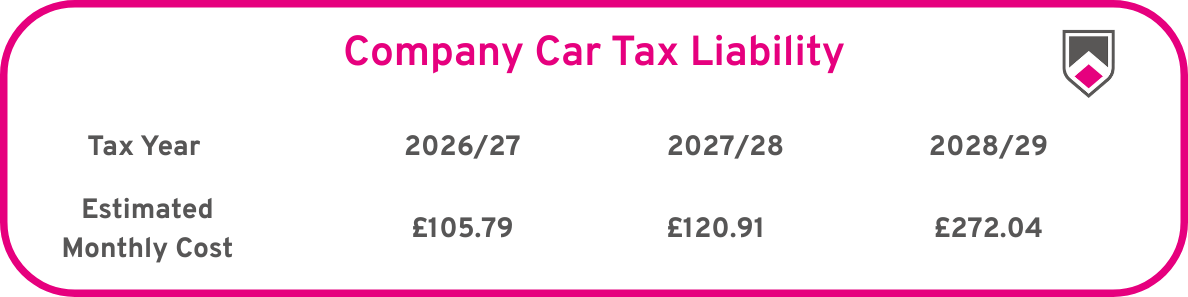
From the 2028/29 tax year, all hybrids within this emissions band will move to a flat 18% BiK rate, increasing to 19% in 2029/30, regardless of how far they can travel on electric power alone.
For drivers currently benefiting from lower rates due to strong electric range figures, this represents a significant shift. The tax advantage that once made certain plug-in hybrids attractive for company car fleets will narrow considerably, and in many cases may alter the overall value proposition.
If you are considering leasing a hybrid through your business, contract length now matters more than ever. A standard three or four-year agreement could run straight into these higher BiK years, materially increasing your personal tax bill part way through the term. A two-year contract offers more protection, keeping you within the current tax window and giving you flexibility to reassess once the new rates take effect.
Below is an example of how the increase might look if you took out a lease for 36 – 48 months from now:
What is the best choice for keeping my tax as low as possible?
Unsurprisingly, if your sole objective is to minimise company car tax, a fully electric vehicle remains the most efficient route. The BiK differential is clear and the long-term direction of travel is even clearer.
But that’s not why you’re here, is it?
There is still a window where the right hybrid can make sense through a business, particularly if you structure it correctly and understand the tax timeline. So, while that window remains open, let’s look at some of the strongest plug-in hybrid options currently worth considering.
1. 2025 Range Rover Sport
Arguably the benchmark luxury SUV, the Range Rover Sport PHEV offers up to 75 miles of electric-only range. That places it in the 6% BiK band for 2026/27.
For a vehicle of this size and status, that remains highly competitive from a tax perspective. With specifications ranging from SE to Autobiography, it delivers serious road presence alongside genuine comfort.
Certain versions exceed £100,000, and the Expensive Car Supplement is a separate consideration. However, strong residual values continue to support attractive lease structures relative to list price.
2. Toyota RAV4
The RAV4 PHEV offers up to 46 miles of electric-only range, positioning it in the 9% BiK band for 2026/27.
Reliable, practical and sensibly priced, it remains a strong option for business users who want tax efficiency without moving into the premium German space. Pricing typically starts in the mid-£40,000s, making it a well-balanced proposition.
3. BMW X5
The latest BMW X5 xDrive50e delivers up to around 68–70 miles of electric range depending on specification. Most variants will sit in the 9% BiK band, although certified 70+ mile versions may qualify for 6%.
It remains one of the most complete large SUVs on the market, blending strong performance with refinement and advanced cabin technology. Pricing generally begins north of £75,000, but structured correctly, it still offers credible efficiency relative to size and output.

4. Mercedes GLC300e AMG Line:
With an electric-only range of up to 80 miles, the latest GLC 300e firmly qualifies for the 6% BiK band in 2026/27.
For many drivers, that electric range means daily use can be almost entirely electric. Combined with Mercedes’ latest interior technology and premium feel, it stands out as one of the most tax-efficient mid-size SUVs available.
5. Mercedes C300e AMG Line:
The C300e offers electric range typically in excess of 60 miles, placing it in the 9% BiK band for 2026/27.
For drivers who prefer a saloon over an SUV, it delivers executive refinement, impressive interior design and meaningful tax efficiency when structured within the current window.
6. Volvo XC60
The XC60 PHEV provides up to around 47 miles of electric-only range, which places it in the 9% BiK band for 2026/27.
Understated, safe and comfortable, it remains a strong choice for business users seeking Scandinavian design and everyday usability with improved tax positioning versus petrol or diesel alternatives.
8. Audi Q5 50 TFSIe:
The Audi Q5 PHEV offers electric-only range around 37–40 miles depending on specification. Most versions therefore sit within the 13% BiK band for 2026/27, although higher-range updates may fall into the 9% bracket if exceeding 40 miles officially.
It is less tax-efficient than some rivals, but often benefits from stronger availability and broader specification flexibility.
Want to find out more?
In the market for a Plug-In-Hybrid? P+B offers a better way to lease a new car for busy professionals who are tired of biased advice or bewildering online portals that make car buying even more of a hassle. We constantly monitor the market on your behalf, doing the trawling so you don’t have to. Our advice is completely impartial, with transparent commission based on the level of service we provide, not the price tag of your vehicle. This means you know all of your costs upfront, and you don’t get caught out by hidden fees. It’s this commitment to clarity and fairness that underpins what we do.
Share this post